
 Botswana
 Zambia
 Congo
Congo Colombia
 China mainland
 Chile
Chile Chad
Chad Central African Republic
 Canada
 Cameroon
 Cambodia
 Burkina Faso
 Bulgaria
 Brunei Darussalam
 Brazil
 Aland Islands
 Bosnia and Herzegovina
 Bolivia
 Belgium
 Belarus
 Bangladesh
 Bahrain
 Azerbaijan
 Austria
 Australia
 Armenia
 Argentina
 Algeria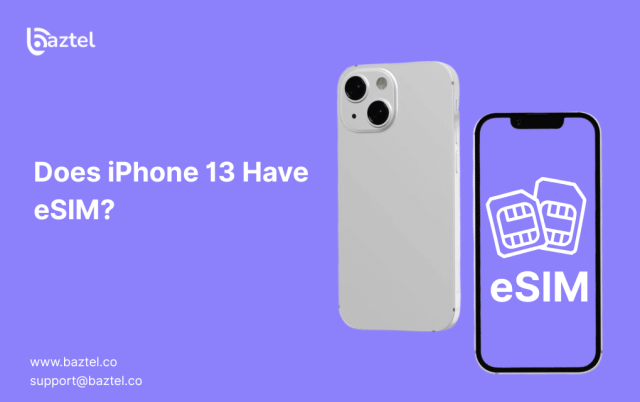

Mobile technology keeps on changing at a very fast rate, and Apple is still the leader in this change. The most important development that is changing the concept of the smartphone of the modern era is the use of eSIM, which is an electronic SIM that does not require a physical card. As telecom operators implement digital provisioning and seamless connectivity in their networks, consumers are enabled for instant network activation, easy plan switching, and secure identity management.
However, eSIM availability depends on your iPhone 13 model, carrier support, and region. Before purchasing or activating, users should consult a comprehensive guide to verify eSIM compatibility for their specific needs.
So, the question many buyers and Apple users are wondering is: does iPhone 13 have eSIM or not? The response is very important; only travelers, business professionals, and people who are living the lifestyle of mobile number management would understand this.
In this blog, we will be discussing how the iPhone 13 can be used with an eSIM, its benefits over the use of a traditional SIM card, the activation process, and the reasons why the iPhone 13 is a device that is ready for the future in a digital ecosystem that keeps on growing.
Does iPhone 13 Have eSIM?
Yes. All four iPhone 13 models support eSIM technology, along with a traditional nano-SIM slot. However, eSIM compatibility may vary in certain regions, and not all models offer eSIM functionality everywhere. This hybrid system allows users to choose between physical and digital SIM usage.
Models with eSIM Support
| iPhone Model | eSIM Support | Dual SIM Capability | Physical SIM Slot |
| iPhone 13 Mini | Yes, except Mainland China, Hong Kong & Macau | Yes | Yes |
| iPhone 13 | Yes, except Mainland China, Hong Kong & Macau | Yes | Yes |
| iPhone 13 Pro | Yes, except Mainland China, Hong Kong & Macau | Yes | Yes |
| iPhone 13 Pro Max | Yes, except Mainland China, Hong Kong & Macau | Yes | Yes |
Users can operate:
- One physical SIM and one eSIM, or
- Two active eSIMs at the same time or
- Two physical SIMs for iPhone 13 sold in Mainland China, Hong Kong and Macau
This flexibility makes the iPhone 13 a compelling choice for professionals, travelers, and anyone managing multiple numbers.
Understanding eSIM Technology
An eSIM (Embedded Subscriber Identity Module) is a digital SIM built directly into the device’s motherboard. Unlike removable SIM cards, eSIM doesn’t require insertion or replacement. Activation is performed digitally via a QR code or carrier provisioning process.
To check if your devices support eSIM, you can verify the presence of an EID number in your device settings by dialing *#06# on your phone. If the EID number appears when you check your device information, your device supports eSIM functionality.
Additionally, eSIM technology provides a more space-efficient design by eliminating the need for a second physical SIM tray.
Key Benefits of eSIM
- No physical SIM handling
- Faster carrier switching
- Increased security, as it cannot be removed physically
- Reduced waste and aligns with eco-friendly initiatives
- Multiple profiles stored on a single device
Key Features of eSIM on iPhone 13
The adoption of eSIM technology in the iPhone 13 marks a very smart and future-ready mobile connectivity solution. Users are benefitting from the features like dual SIM support, multiple stored profiles, and full 5G compatibility that provide them with the flexibility, security, and convenience. These features are making the phone a perfect device for contemporary communication requirements in the personal, professional, and international usage scenarios.
eSIM features and activation on the iPhone 13 depend on carrier support and compatibility with the carrier’s network. Users should check with their service provider to ensure their plan and device are compatible with eSIM. If the device is locked, both plans may need to be from the same carrier for dual SIM functionality.
1. Dual SIM Functionality
The iPhone 13 has the functionality of dual SIM cards, which is very flexible. This means that the users can either have one physical nano-SIM along with an eSIM, or they can use two digital eSIMs at the same time.
With dual SIM functionality, users can manage two lines for phone calls, voice and data, and cellular data, making it easy to switch between personal and business numbers or different carriers. The iPhone displays dual SIM status icons and signal strength indicators for each active line, so you can easily monitor the connection quality of both SIMs.
Users can also label their eSIM plans to easily identify which number to use for calls and messages. This feature is very helpful for users managing both business and personal numbers, for travelers or for users who want to have different local and international plans on their single phone.
2. Multiple Stored Profiles
One of the standout features of the iPhone 13 is that it can hold a number of eSIM profiles right on the device, which means that the user can easily select between the different carriers or plans for a specific area without going through the cumbersome process of reconfiguring.
Users can add a data plan by scanning a QR code or entering details in the settings app, and once multiple eSIM profiles are stored, they can switch between them in the settings without needing to scan QR codes again. Only one cellular data network can be active at a time, but users can easily switch between different plans for optimal connectivity, making it convenient for managing personal and business lines or for travel.
The downside is that only two profiles can be live at any one time, but nonetheless this feature makes it much easier for frequent travelers, professional people, and anyone else who uses different network services to manage their connectivity issue.
3. 5G Support on eSIM
The iPhone 13 is completely compatible with 5G technology whether you use a traditional SIM card or an eSIM, therefore guaranteeing users the same great speed, area, and network quality no matter what type of SIM is used. This also means that digital SIMs will not have any performance issues related to them, and thus, a smooth upcoming generation of connectivity will be experienced by users from all the 5G carrier networks.
How to Activate eSIM on iPhone 13
Turning on an eSIM on the iPhone 13 is a breeze, and it only takes a few minutes. To activate an eSIM, you typically need an activation code or QR code from your carrier. There are 3 ways in which you can activate a mobile plan on the iPhone 13, so you can choose the most convenient one for you without having to handle the physical SIM.
You can use your camera to scan the QR code provided by your carrier, or enter the details manually if needed. If your carrier doesn’t provide a QR code, you may need to install a carrier app and it will have a feature to carryout the required installation onto your phone. Whichever way you use to move your old plan or to add a new carrier profile, you will always have a comfortable and smooth operation.
Method 1: QR Code Activation
- Open Settings
- Select Cellular or Mobile Data
- Tap Add eSIM or Add Cellular Plan
- Scan the QR code provided by your carrier
- Complete configuration steps and confirm activation
Method 2: Carrier Application
Some carriers allow activation via their mobile apps:
- Install the carrier app
- Sign in and choose Activate eSIM
- Follow the guided steps to enable the plan
Method 3: Manual Installation
You will be provided with a set of numbers from carrier to insert as follows:
- Open Settings
- Select Cellular or Mobile Data
- Tap Add eSIM or Add Cellular Plan
- Select Enter Details Manually
- Type the provided SM-DP+ address and activation code
- Complete configuration steps and confirm activation
Managing eSIM on iPhone 13
Managing eSIM on the iPhone 13 is designed to be intuitive, giving you full control over your mobile plans right from your device. The iPhone 13 can store multiple eSIM profiles, so you can keep different plans for personal calls, work, or travel all on the same device.
This makes it easy to avoid data roaming charges by adding a local data plan when you’re abroad, or to switch between carriers for better rates or coverage. In the Settings app, you can label each plan for quick identification, manage which plan is used for calls, messages, and data, and even set your preferred line for specific contacts.
With eSIM technology, managing your mobile connectivity has never been more flexible or convenient.
eSIM Plans for iPhone 13
eSIM plans for the iPhone 13 unlock a new level of flexibility and convenience for users who want to stay connected wherever they go. With eSIM, you can switch between different carriers and mobile plans without the hassle of swapping out a physical SIM card.
This is especially useful for frequent travelers, as you can add a local data plan in another country to avoid expensive data roaming fees and ensure reliable mobile data access. If you ever change your device, you can transfer your eSIM from one Android phone to another with ease. eSIM plans also make it easy to manage multiple phone numbers on the same device, so you can keep your work and personal calls separate without carrying two phones.
When selecting an eSIM plan for your iPhone 13, consider your data usage needs, the coverage offered by the carrier, and the overall cost to find the best fit. Whether you need a plan for heavy data use, international travel, or simply want to manage multiple phone numbers, eSIM on the iPhone 13 gives you the power to customize your mobile experience and stay connected on your terms.
Data Roaming with eSIM on iPhone 13
With eSIM on the iPhone 13, data roaming becomes more affordable and manageable, especially when traveling internationally. Instead of relying on your home carrier’s roaming rates, you can add a local data plan via eSIM to access lower-cost data and avoid unexpected charges.
To use data roaming with eSIM, first ensure your carrier supports international roaming and that your eSIM plan is compatible with the countries you’ll visit. Then, enable data roaming in your iPhone’s settings and select the eSIM plan you want to use for data.
This allows you to stay connected to the internet, use maps, and keep in touch with friends and family without worrying about excessive fees. Always check with your carrier about data roaming rates and coverage before you travel, as these can vary by region and provider. With the right eSIM plan, your iPhone 13 keeps you connected wherever you go.
Advantages of Using eSIM on iPhone 13
With eSIM technology, the iPhone 13 has elevated the user experience to a great extent, providing more flexibility, convenience, and security than the traditional SIM cards. Travel eSIMs make it easy to access mobile services in different countries, offering convenience and cost savings for international travelers who want to avoid searching for local SIM vendors and can activate competitive local data plans before arrival.
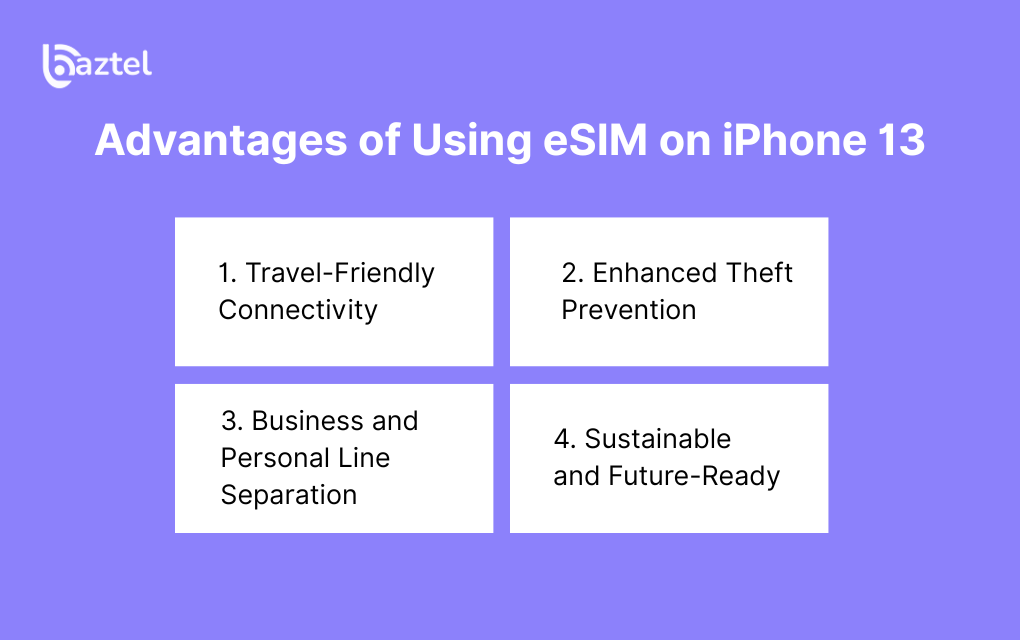
eSIM is a feature that adapts to the ever-changing demands of present-day smartphone users, whether they are going abroad, securing their devices, juggling different numbers, or using a contemporary mobile ecosystem. The following are the advantages we believe iPhone 13 provides:
1. Travel-Friendly Connectivity
The eSIM feature of the iPhone 13 has made the lives of travelers easier by allowing them to buy and turn on data plans, whether regional or international, in no time and without the need to go to a store. This means no more hassle of finding SIM card vendors, dealing with small SIM cards, or having to carry SIM ejector tools. It provides a smooth and dependable connection right after you get to the new place.
2. Enhanced Theft Prevention
The fact that a device comes with an integrated eSIM means that it is not removable like a standard SIM card. Hence, the traceability and the chances of finding an iPhone 13 that has gone missing or has been stolen increase to a great extent. The criminals now find it more difficult to just disconnect the network, thus making the eSIM devices always more secure and less prone to theft compared to their physical SIM counterparts.
3. Business and Personal Line Separation
The iPhone 13’s dual eSIM technology provides the option to keep two active cellular profiles at the same time. This feature is perfect for managing your communications over work and personal without having to carry a secondary phone. Besides, users can change their networks or identities in no time, thus making their professional workflows easier and at the same time keeping their personal life and business activities organized.
4. Sustainable and Future-Ready
The eSIM technology primarily eliminates the need for physical SIM cards, their packages, and the whole process of transporting them, thus causing less plastic waste and having a smaller impact on the environment. When the worldwide network providers gradually take over digital provisioning, the iPhone 13 will place the users at the very front of a much more environmentally friendly, modern, and mobile ecosystem that is created using sustainability and future connectivity standards.
eSIM vs Physical SIM: A Practical Comparison
| Feature | eSIM | Physical SIM |
|---|---|---|
| Setup | Digital | Manual |
| Switching Networks | Instant | Requires replacement |
| Security | Cannot be removed | Removable |
| Travel Convenience | High | Limited |
| Environmental Impact | Reduced waste | Plastic-based |
| Long-Term Viability | Increasing | Declining |
The iPhone XS was one of the first iPhone models to support eSIM, paving the way for later models like the iPhone 13 to offer enhanced dual SIM and connectivity features.
eSIM provides a superior and modern connectivity experience, positioning the iPhone 13 as a future-proof device.
Support and Troubleshooting for eSIM on iPhone 13
If you run into issues with eSIM on your iPhone 13, there are several steps you can take to resolve them quickly. First, double-check that your iPhone 13 is eSIM compatible and that your carrier supports eSIM technology.
If you’re having trouble activating a plan, make sure you have a stable internet connection and that you’ve scanned the QR code correctly. For problems with data roaming or coverage, contact your carrier to confirm their international roaming policies and network availability in your destination.
If you experience persistent issues, try resetting your network settings by going to Settings > General > Reset > Reset Network Settings, or simply restart your device. For more complex problems, visit the Apple Support website or reach out to your carrier’s customer service for personalized assistance.
By following these troubleshooting steps, you can ensure your iPhone 13’s eSIM functionality works smoothly, keeping you connected wherever you are.
Conclusion
Does iPhone 13 have eSIM? The response to this question is a clear yes. Every model of the iPhone 13 series is compatible with eSIM and is using it in a way that provides better connections, simple handling of the networks, and security that is very strong. As the telecommunication industry is moving towards digital SIM technology, the iPhone 13 is still the perfect gadget for people who want to be the first to experience mobile communication’s next evolution.
FAQ
Does iPhone 13 have eSIM?
Absolutely. With eSIM support already in every iPhone 13 model, it is possible for users to carry out the process of activating mobile subscriptions online without the need for a physical SIM card.
Is it possible for the iPhone 13 to use two SIM cards at once?
The iPhone 13 has the capability for dual SIM use, thus permitting the users to simultaneously operate two eSIMs or mix one physical SIM with one eSIM for more versatility.
Will the choice of eSIM have an effect on quality or speed?
Definitely not. The users of the iPhone 13 will experience equivalent performance and speed whether they are using eSIM or SIM. The phone has full 5G support and will not make any differentiations regarding the quality of the network when it comes to eSIM or physical SIM usage.
Is eSIM technology safe?
Of course. eSIM technology is protected, as it gets its full security from being a permanent part of the mobile device, and it also cannot be taken out, thus making it difficult for unauthorized persons to interfere with or take away the mobile identity data.
How many eSIM profiles can the iPhone 13 accommodate?
The iPhone 13 is capable of holding various eSIM profiles, which makes it easy for the user to change the network quickly. Nevertheless, only two profiles can be active on the device at one time.

Blog Author
Peter
I'm Peter, the founder of BazTel. I built this company at the intersection of two things I know well: finance and travel. Before starting BazTel, I worked in investment analytics at State Street, one of the world's largest custodian banks, and later at TCorp, the New South Wales Government's investment…


